
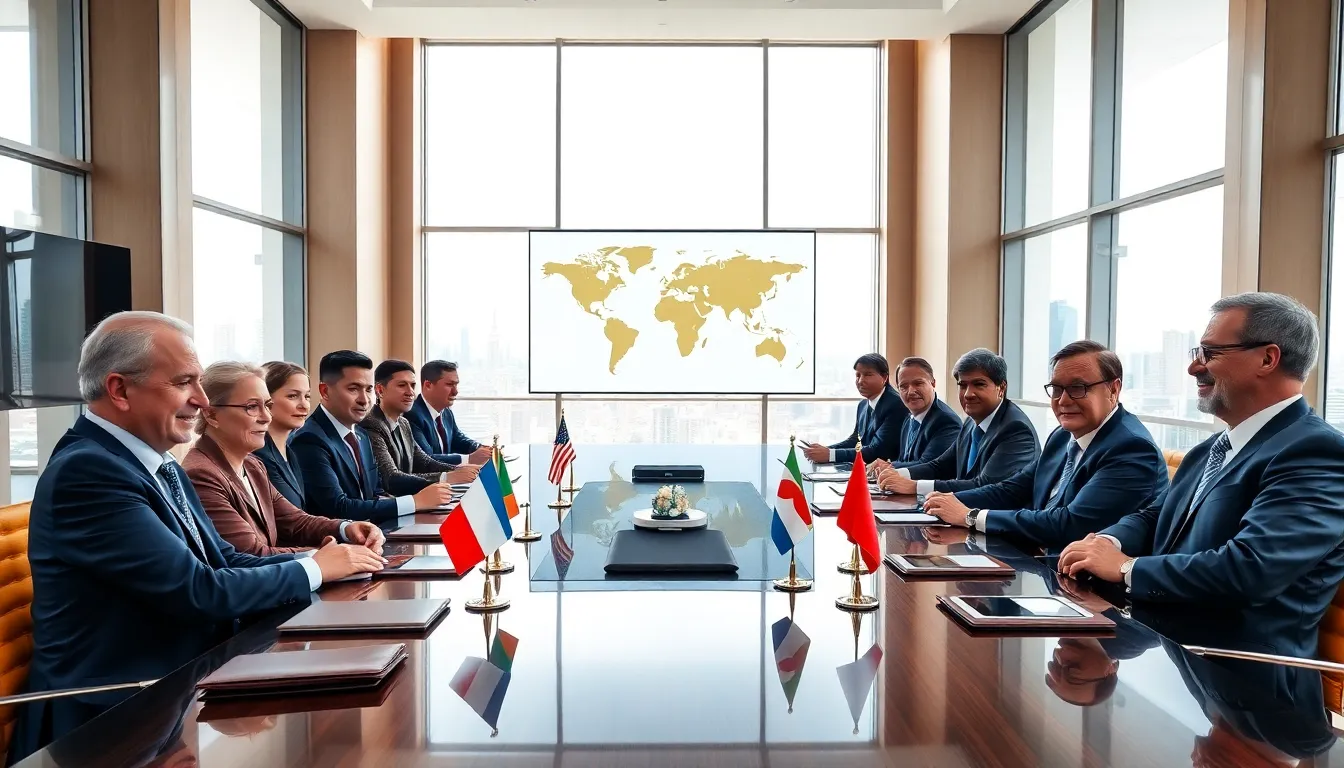
Top global affairs in 2025 are reshaping international relations at a rapid pace. From shifting alliances to economic uncertainty, the year has brought significant changes that affect nations and citizens alike. Governments are responding to new challenges while balancing long-standing priorities. This article examines the most pressing global affairs topics, geopolitical tensions, economic developments, climate initiatives, and security concerns, that define this pivotal year.
Table of Contents
ToggleKey Takeaways
- Top global affairs in 2025 are defined by intensifying U.S.-China-Russia tensions, shifting alliances, and emerging powers demanding greater representation in global institutions.
- Economic challenges including record global debt exceeding $100 trillion and persistent inflation are forcing governments to balance growth with financial stability.
- Climate action has become urgent, with COP30 in Brazil set to address the gap between current emissions pledges and the 1.5°C warming limit.
- Supply chain diversification and “friend-shoring” are reshaping trade as companies move production based on political alignments rather than purely economic factors.
- Cybersecurity and AI-driven threats represent new frontline security concerns, with state-sponsored attacks targeting critical infrastructure worldwide.
- Understanding these top global affairs developments helps citizens and organizations prepare for ongoing geopolitical, economic, and environmental shifts.
Geopolitical Tensions and Diplomatic Shifts
Geopolitical tensions have intensified across multiple regions in 2025. The relationship between major powers continues to strain, with the United States, China, and Russia pursuing competing interests. These top global affairs developments are creating ripple effects worldwide.
The U.S.-China relationship remains a central concern. Trade restrictions, technology disputes, and Taiwan-related friction dominate headlines. Both nations have expanded their diplomatic outreach to secure allies in Africa, Southeast Asia, and Latin America. This competition for influence shapes policy decisions in dozens of countries.
Russia’s position on the global stage has also shifted. Sanctions remain in place, and European nations continue to reduce energy dependence on Russian supplies. Meanwhile, Moscow has strengthened ties with China, Iran, and several African states. These partnerships alter traditional alliance structures.
Diplomatic shifts are visible in unexpected places. Middle Eastern nations are forging new agreements with former adversaries. India has become a more prominent voice in international forums, leveraging its growing economic power. Brazil and other emerging economies are demanding greater representation in global institutions.
The United Nations faces pressure to reform. Many member states argue that the Security Council structure no longer reflects current realities. Calls for expanded permanent membership have grown louder, though consensus remains elusive.
These geopolitical changes affect everyday people. Supply chains shift based on political alignments. Travel and immigration policies change. Businesses must adapt to new regulations and restrictions. Understanding these top global affairs helps citizens and organizations prepare for what lies ahead.
Economic Challenges and Trade Developments
Economic challenges rank among the top global affairs concerns for 2025. Inflation, debt levels, and trade disputes are testing governments worldwide. Central banks continue to balance growth with price stability.
Inflation has moderated in many developed economies, but it remains elevated compared to pre-2020 levels. The United States, European Union, and United Kingdom have maintained relatively high interest rates. These policies slow economic growth while controlling prices. Developing nations face even greater pressure, as currency fluctuations erode purchasing power.
Global debt has reached record levels. The International Monetary Fund reports that public debt exceeds $100 trillion globally. Many countries spend significant portions of their budgets on interest payments alone. This limits investment in infrastructure, education, and healthcare.
Trade relationships are evolving rapidly. The United States has maintained tariffs on Chinese goods and added new restrictions on technology exports. China has responded with its own measures. This back-and-forth creates uncertainty for businesses operating in both markets.
Regional trade agreements are gaining importance. The Regional Comprehensive Economic Partnership (RCEP) in Asia continues to expand. African nations are implementing the African Continental Free Trade Area. These agreements create new opportunities while shifting traditional trade patterns.
Supply chain diversification remains a priority. Companies are moving production out of China to Vietnam, India, Mexico, and other locations. This “friend-shoring” trend reflects political concerns as much as economic calculations.
Energy prices continue to influence economic conditions. Oil and natural gas markets remain volatile. The transition to renewable energy creates both opportunities and disruptions. Nations rich in critical minerals, lithium, cobalt, rare earth elements, hold new strategic importance in these top global affairs discussions.
Climate Action and Environmental Agreements
Climate action has become one of the most urgent top global affairs priorities. Extreme weather events, rising sea levels, and ecosystem degradation are forcing governments to act. International agreements and national policies are evolving in response.
The Paris Agreement remains the foundation of global climate cooperation. Nations have submitted updated commitments for emissions reductions. But, scientists warn that current pledges fall short of limiting warming to 1.5 degrees Celsius. The gap between promises and action persists.
COP30, scheduled for later in 2025, will test international resolve. Brazil is hosting the conference, putting Amazon deforestation in the spotlight. Negotiations will focus on climate finance, specifically, how wealthy nations will support developing countries in reducing emissions and adapting to climate impacts.
Renewable energy deployment has accelerated dramatically. Solar and wind power now account for a growing share of electricity generation worldwide. China leads in manufacturing capacity, while the United States and Europe invest heavily in domestic production. This competition drives down costs but also raises trade tensions.
Electric vehicle adoption continues to expand. Major automakers have committed to phasing out internal combustion engines. Charging infrastructure is improving, though unevenly distributed across regions. Battery technology advances are making EVs more practical for consumers.
Climate-related migration is increasing. Droughts, floods, and storms are displacing millions of people. This movement creates humanitarian challenges and political tensions. Many top global affairs experts consider climate migration among the most significant long-term issues.
Biodiversity loss has also gained attention. The Global Biodiversity Framework, agreed upon in 2022, sets targets for protecting ecosystems. Progress toward these goals has been mixed. Conservation efforts compete with economic development pressures in many regions.
Emerging Security Concerns and Conflicts
Security concerns represent critical top global affairs issues in 2025. Active conflicts, terrorism threats, and new forms of warfare demand attention from policymakers and citizens alike.
The conflict in Ukraine continues with no clear resolution. Fighting has slowed in some areas, but casualties mount on both sides. Peace negotiations have stalled repeatedly. The war’s impact extends beyond the battlefield, food prices, refugee flows, and military spending patterns all reflect its influence.
Middle Eastern instability persists. Tensions between Israel and its neighbors remain high. Iran’s nuclear program generates ongoing concern among Western nations. Regional proxy conflicts complicate diplomatic efforts.
Africa faces multiple security challenges. Armed groups operate across the Sahel region. Coups have occurred in several countries over the past few years. International peacekeeping missions have scaled back, leaving some nations more vulnerable.
Cybersecurity has become a frontline concern. State-sponsored hackers target critical infrastructure, financial systems, and government agencies. Ransomware attacks affect hospitals, schools, and businesses. Nations are investing heavily in both offensive and defensive cyber capabilities.
Artificial intelligence introduces new security dimensions. Autonomous weapons systems raise ethical questions. AI-generated disinformation threatens democratic processes. Governments are struggling to regulate these technologies effectively.
Nuclear proliferation remains a concern. North Korea continues its weapons program. Talks with Iran have produced limited results. The global nonproliferation framework faces pressure from multiple directions.
These top global affairs security challenges require international cooperation. Yet cooperation is harder to achieve when trust between major powers is low. Finding common ground on security issues may be the defining challenge of this era.